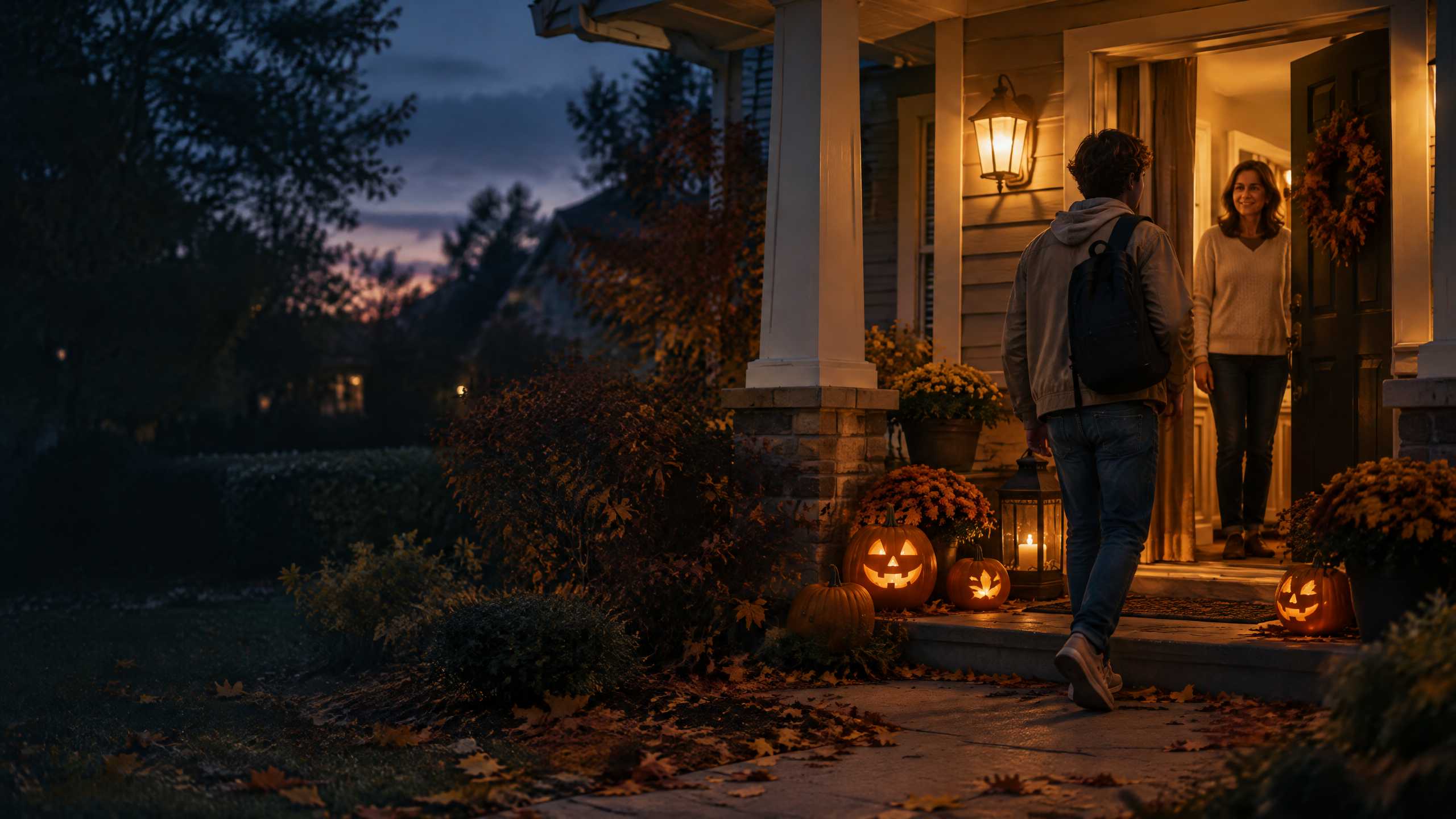
Every fall, the same questions come back around in Christian homes. Your teen wants to see the horror movie everyone at school is talking about, play a scary game with friends over headsets, or walk the haunted trail at the farm down the road. You are not sure whether to say yes, no, or “let me think about it.” Then there is Halloween itself, which some churches celebrate with open arms and others will not go near.
This guide is meant to stay useful year after year. It will not tell you which movies are worth seeing this season. Instead, it explains why many teenagers go looking for fear on purpose, what the research says that fear does and does not do, how to tell a healthy scare from the kind worth worrying about, how Christians have thought about darkness and Halloween, and what to ask before your family presses play.
Faithful Christian families land in different places on Halloween. This is not an argument for one family’s choice. It is a guide to understand the options clearly, make your own decisions thoughtfully, and keep the conversation open with your teen.
The Short Version
Wanting to be scared is normal, and for most teens it is closer to a roller coaster than a red flag.
Research suggests a just-right amount of fear is enjoyable and may help some people practice handling hard emotions, though the studies are still early.
Teens who love horror tend to be thrill-seekers, nerve-testers, or people working through something difficult. That last group deserves the closest attention.
The biggest concerns are usually not fear itself, but cruelty, sexualized violence, and occult practice presented as something to try.
Scripture takes evil seriously while insisting it has already been defeated. Families can face darkness without being ruled by it.
The best protection is a parent who watches alongside, asks good questions, and talks it through afterward.
The Strange Appeal of Being Scared
Most of us spend a good part of parenting trying to keep our children from being afraid, which is why it can feel odd when a teenager goes looking for fear on purpose. They pay money to walk through a dark barn while actors with chainsaws chase them. They watch videos about abandoned hospitals at midnight. They play games designed to make them scream into a headset while their friends laugh at them.
Researchers call this the horror paradox: most people would rather feel good than frightened, yet many actively seek fear in a safe setting. The appetite is not new. Ghost stories around a fire, fairy tales where children get lost in the woods, and the campfire legend every summer camp seems to have all come from the same impulse to brush up against danger from a safe distance.
Choosing to be scared, which researchers call recreational fear, is a normal and widely shared experience. The harder work is telling the difference between fear that stretches a teen and content that harms one.
What the Research Says
There is a sweet spot
Association for Psychological Science ↗Researchers followed 110 people through a nearly 50-room commercial haunted house in Denmark, tracking heart rate and asking how frightened and entertained they felt. Enjoyment rose with fear up to a point and then fell off. The people who had the most fun were scared a fair amount, but not overwhelmed. Researchers call it a Goldilocks zone: the goal is not the scariest possible experience, but the right amount for a particular person.
It may be practice for real fear
Pandemic Practice study ↗In the early months of COVID-19, horror fans reported less psychological distress than other people, and fans of apocalyptic, zombie, and alien-invasion stories reported feeling more prepared. One explanation is that frightening stories let people practice managing hard emotions where they are actually safe. The finding shows a connection, not proof that horror causes resilience, and the broader research field is still small enough to hold loosely.
Why the teenage years can feel intense
BrainFacts / Society for Neuroscience ↗During adolescence, emotional processing is especially active while the parts of the brain involved in long-range planning and impulse control are still developing. Emotional experiences can feel bigger and stick harder. Sitting through something frightening, or making it through the haunted house without bolting for the exit, can become a small rite of passage: a way for a teen to learn what they can handle.
Fear is usually social
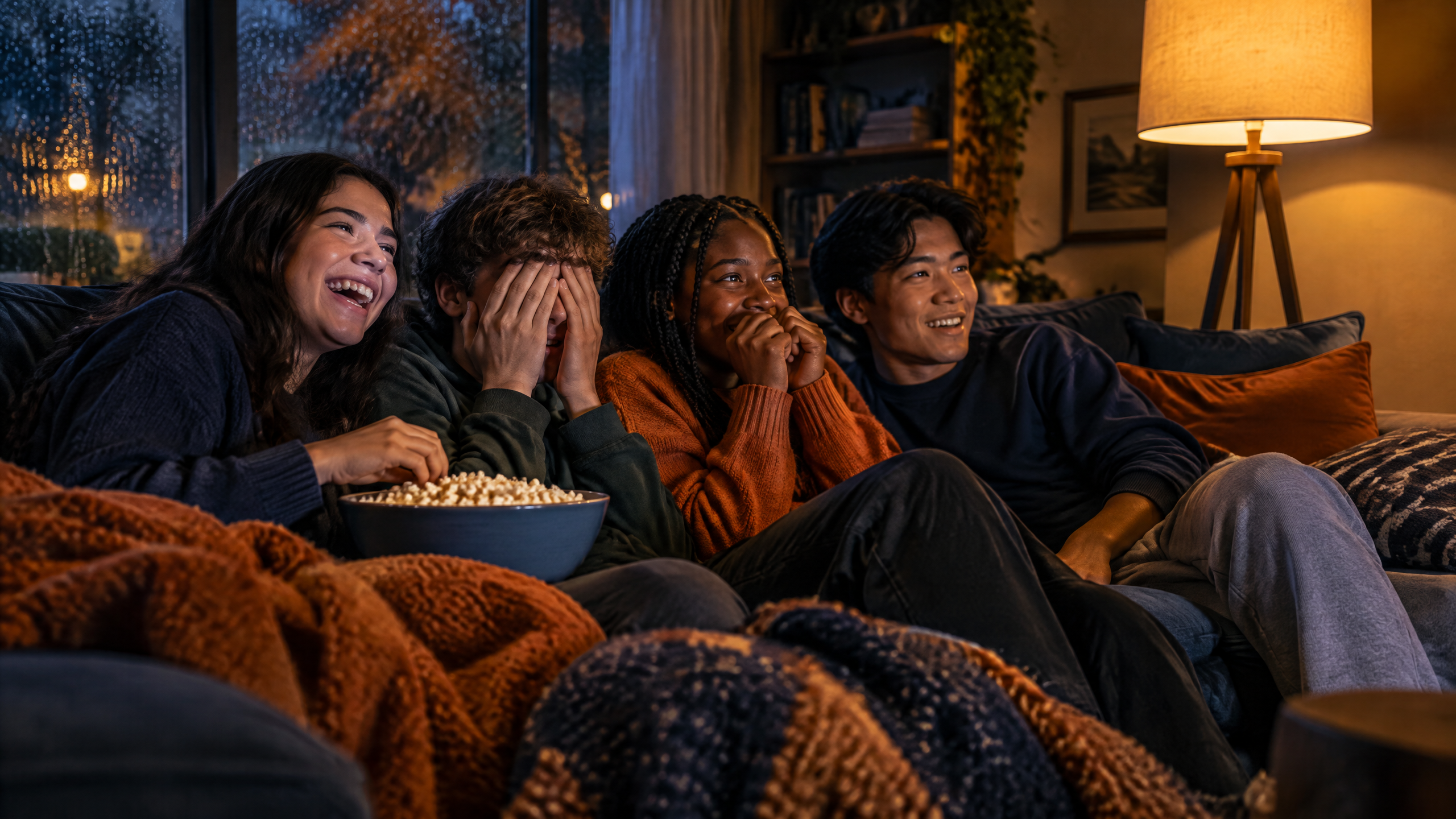
NPR interview with Coltan Scrivner ↗Teens rarely seek out fear alone. They go to the attraction in a group, watch the movie at a sleepover, and play the horror game with friends on voice chat. Laughter and shared nerves are a large part of why groups do this together. When your teen asks to go to the scary movie, they may be asking just as much to be included with friends as to be frightened.
Three Kinds of Scare-Seekers
The Aarhus researchers have found that people who enjoy fear tend to fall into three broad groups. They are not diagnoses, and plenty of teens drift between them. But they can explain why two siblings walk out of the same movie with completely different reactions.
Adrenaline junkies
They want the jump scare, racing heart, and good mood afterward. Horror often works like a roller coaster. Watch how far they push to chase a bigger thrill and whether that same appetite shows up in riskier places.
White knucklers
They are genuinely scared and go anyway. They cover their eyes, grab the person beside them, and come out proud that they faced something hard. Let them choose their level, with no teasing for stepping out.
Dark copers
They use frightening or grim stories to work through anxiety, grief, or a fear about the world they cannot quite put into words. Stay curious: a teen who is processing something dark needs a person, not just a movie.
A Field Guide to What They Are Watching and Playing
Titles come and go every October, but the kinds of horror teens gravitate to stay remarkably steady. When your teen mentions something you have not heard of, it usually fits one of these categories. Knowing the category tells you a lot about what you are likely to find inside it.
Slashers
A killer, often masked, stalks a group of young people one by one.
Look for: Usually more gore than dread. Check how long the camera stays on suffering, and whether violence is mixed with sexual content.
Supernatural & haunting
Ghosts, demons, possession, cursed objects, and haunted houses.
Look for: Often the least graphic and most frightening. Notice how the story treats evil and the spiritual world, and whether it presents occult practice as something to try.
Psychological horror
Fear built from the mind: paranoia, isolation, unreliable reality, and slow dread.
Look for: Can stay with a teen longer than gore does. Worth checking for themes of suicide, self-harm, or mental illness.
Creature, apocalypse & zombie
Monsters, outbreaks, the end of the world, and survival against the odds.
Look for: Often the most rehearsal-like, with questions about courage, sacrifice, and what people owe each other. Violence levels vary widely.
Found footage & analog horror
Stories presented as real recordings, from shaky home video to fake VHS tapes and emergency broadcasts.
Look for: Low-budget and easy to find without a parent knowing. The ‘is this real?’ feeling can unsettle younger teens more than a polished movie would.
Horror video games
Solo story games and co-op games where friends survive, or fail, together on voice chat.
Look for: Check the age rating, but also ask whether they are playing or mostly watching streamers play, since streamer commentary brings its own language and humor.
Haunted attractions
Haunted houses, trails, corn mazes, and theme-park scare events with live actors.
Look for: Some extreme attractions involve physical contact or require a signed waiver. Ask who is going and how they are getting home.
Scary short-form content
Creepy story narrations, internet legends, eerie empty-building images, and supposedly true paranormal clips.
Look for: Endless and algorithm-fed, so it is easy to fall into late at night. Some of it drifts into try-this-at-home summoning challenges.
True crime is not technically horror, but many teens consume it alongside horror. It deserves its own thought, since the victims in those stories were real people with families who may still be living with what happened.
Where to Pay Closer Attention
If the research is encouraging about fear in general, it says much less about everything else that tends to come packaged with horror. Most of the real concerns for Christian parents are not about being frightened at all, and it helps to separate them out.
Being scared versus being degraded
A story can be terrifying without lingering on cruelty. The content worth a harder look is the kind that invites the audience to enjoy suffering: long, detailed torture scenes, violence played for laughs, and especially violence mixed with sexual content. A useful question for any title is whether it wants you to fear evil or to relish it.
Evil as a villain versus the occult as a hobby
Stories can feature demons, curses, and the devil as the enemy. That differs from content that treats occult practice as something to try: online summoning challenges, Ouija sessions at a sleepover, or videos teaching rituals and spells. Deuteronomy 18:10–12 is direct about this second category, and it is reasonable for a family to draw a firmer line there.
What happens after the movie ends
Some teens shake off a scary film before the credits finish. Others lie awake for a week. Trouble sleeping, new fears that do not fade, or a teen who suddenly does not want to be alone in the house are signs an experience went past their Goldilocks zone. That is information, not failure. Make it easy for them to say no or call for a ride without losing face.
When the darkness is coming from inside
Most teens who love horror are simply enjoying a genre. But if an interest narrows toward death, suicide, or self-harm in particular, or your teen seems withdrawn or hopeless alongside it, choose a gentle, direct conversation rather than only a new rule. Ask what they like about it and what it makes them feel.
If you need help
If you are worried your teen may be thinking about suicide or self-harm, call or text 988 in the United States, or contact local emergency services if there is immediate danger. A family doctor, school counselor, or pastor you trust can also help you think through next steps.
How Christians Can Think About Darkness and Fear
Scripture is unflinching about darkness. It includes a king who visits a medium to call up a dead prophet, stories of violence in Judges that most of us would rather not read aloud at dinner, and psalms written from inside fear and despair. The Bible does not pretend evil is imaginary, and it does not ask God’s people to pretend they are never afraid. What it does, again and again, is refuse to let fear have the last word.
Fear itself is not a flaw. God built it into us as a warning system. Scripture even treats one kind of fear, the fear of the Lord, as the place wisdom begins. What the Bible pushes back on is fear that takes over a person’s life. Courage has never meant feeling no fear. It means finding a steadier reason to keep going.
“Even though I walk through the valley of the shadow of death, I will fear no evil, for you are with me; your rod and your staff, they comfort me.”
Psalm 23:4 (ESV)
The comfort David describes is not the absence of the valley, but the presence of the shepherd in it. That is a helpful way to talk with a teen who likes to test their nerve.
“He disarmed the rulers and authorities and put them to open shame, by triumphing over them in him.”
Colossians 2:15 (ESV)
This gives Christian families a reason to take evil seriously without being ruled by it. Many horror stories borrow from a Christian picture of the world in which evil is real, there is a line you should not cross, and sacrifice can defeat darkness. What they usually leave out is that, in the Christian story, the decisive battle has already been won.
“There is no fear in love, but perfect love casts out fear. For fear has to do with punishment, and whoever fears has not been perfected in love.”
1 John 4:18 (ESV)
John is writing about fear of God’s judgment, not haunted houses. But the distinction is still useful: fear we choose and survive can be a kind of play, while fear that grips us and will not let go calls for a different answer.
What About Halloween Itself?
Horror movies and Halloween overlap, but they are different questions. A family might skip Halloween entirely and still allow a carefully chosen scary movie in February, or hand out candy every October 31 and never let a slasher film in the house.
A short history
The name comes from the church calendar. To hallow something is to treat it as holy, and hallow was once a word for a saint. In the eighth century, Pope Gregory III called for November 1 to be All Saints’ Day, and the evening before became known as All Hallows’ Eve. Centuries later, October 31 also became Reformation Day for many Protestants, marking Martin Luther’s Ninety-Five Theses in 1517.
Many accounts connect the night to Samhain, a Celtic festival marking the end of harvest and the start of winter. But historians disagree about how much of Samhain survived across the centuries. Most of what Americans now think of as Halloween took shape much later, when Irish and Scottish immigrants brought folk customs to the United States. The history is worth holding with both curiosity and humility.
Three faithful approaches
Sitting it out
Some families do not take part because of the day’s associations with death, the occult, and the celebration of evil. For many, it is a settled conscience decision that deserves respect.
Reshaping it
Some keep the date but change its meaning: a harvest festival, trunk-or-treat, Reformation Day, All Saints’ Day, or costumes with clear family limits.
Joining in thoughtfully
Others participate as neighbors, keeping the porch light on, giving generously, and using judgment about costumes, parties, and which houses are worth skipping.
“One person esteems one day as better than another, while another esteems all days alike. Each one should be fully convinced in his own mind.”
Romans 14:5 (ESV)
Whatever your family decides, explain the reasons to your teen rather than only giving the rule. Offer them a respectful way to talk about friends whose families made a different decision.
A note for parents of older teens
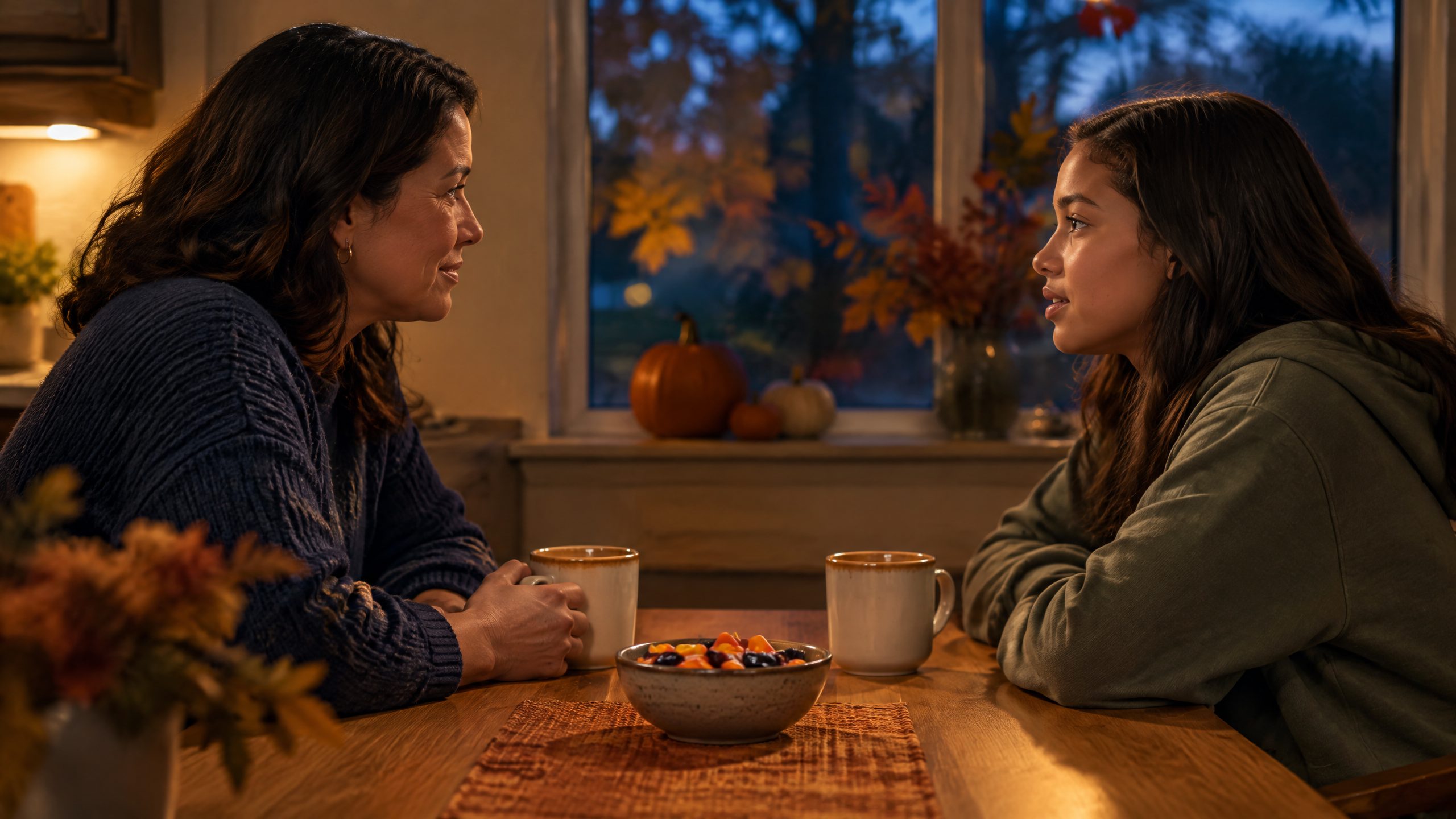
By high school, trick-or-treating often gives way to parties, haunted attractions, scary movie nights, and sometimes pranks that go too far. Ask the ordinary questions you would ask about any Friday night: where they will be, who is driving, whether an adult will be home, and what the plan is if things start to feel wrong. A calm conversation about what they hope the night will be like usually does more good than a list of rules.
Age by Age
Every teen is different. A sensitive fifteen-year-old may need more care than a steady twelve-year-old. These are starting points rather than rules, and age ratings are a floor for your own judgment rather than a ceiling.
Tweens · roughly 10–12
The line between pretend and could-this-happen is still thin, and images tend to stick. Spooky-but-safe stories, mysteries, and family films with a few jump scares often fit the Goldilocks zone. Watching together and a friendly rule that anyone can say pause at any time make a real difference.
Younger teens · roughly 13–15
Peer pressure around scary content often peaks here because being able to handle it becomes part of fitting in. Check a detailed content review, not just the rating. Talk ahead of time about what your teen will do if the group puts on something they do not want to watch, and make it easy to text for a ride home.
Older teens · roughly 16–18
The goal shifts from controlling everything to building judgment they will take with them. Watch something together and talk afterward as two people who can both think. Older teens can learn to tell the difference between restrained, thoughtful horror and content that is mostly gore and sexual violence if someone walks through it with them a few times.
Before You Press Play
When a specific movie, game, or event is on the table, these questions can help you decide together. Working through them with your teen, rather than for them, is often more valuable than the decision itself.
- 1What kind of scary is it?Is the fear built from suspense and dread, or mostly from gore and cruelty?
- 2Does it want us to fear evil or enjoy it?Notice whether the story treats suffering as something terrible or as entertainment.
- 3How does it treat the spiritual world?A demon as a villain is different from a story or video that presents occult practice as something to try.
- 4Is sexual content mixed with violence?This is the combination most worth avoiding at any age.
- 5Who chose it?Make sure the quieter person in the room has a real way to opt out.
- 6Is this the right amount of scary for this teen?Think about how they handled the last scary thing and how they have been sleeping lately.
- 7What is going on in their life right now?A teen dealing with grief, anxiety, or a hard season may need a lighter choice or a conversation first.
- 8Will we be able to talk about it afterward?If the answer is yes, many borderline choices become easier to navigate.
Conversation Starters
These work best in low-pressure moments: a car ride home from the haunted trail, the walk to the kitchen after a movie, or a quiet evening when nobody has to make eye contact. Pick one or two rather than running through the list.
Before
What is the scariest thing you have ever watched or played, and did you enjoy it?
When you are scared during a movie, what do you do?
Is there anything you would never want to watch, even if your friends were all into it?
After
What was the scariest moment, and why did that part get to you?
Who was the bravest character, and what made them brave?
Did the story have a clear line between good and evil? Who decided where that line was?
About Halloween
What do your friends’ families do on Halloween, and what do you think of the way we handle it?
If you were in charge of our family’s October 31, what would you keep and what would you change?
The Bridge Moment
“What do you think makes a story scary in a good way, and what makes it feel wrong?”
Then listen. The answer will tell you far more about your teen’s imagination, friendships, and sense of safety than a rule alone can.
Sources & Further Reading
The guide retains the supplied research and history sources for readers who want to go deeper. Research findings are useful for conversation, not a substitute for knowing your particular teen.